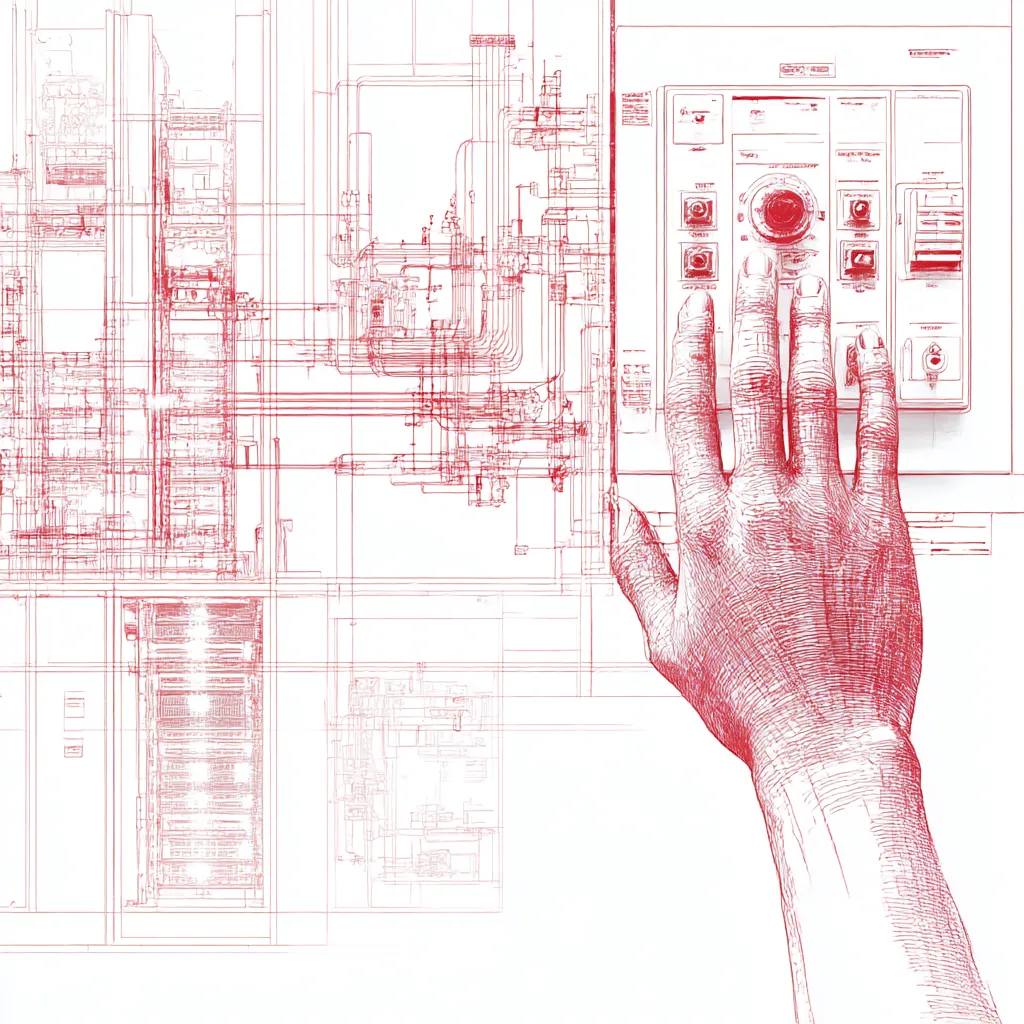
Human Primacy is not a claim of human supremacy over the natural world; the project’s commitment to the rights of living systems is articulated under Ecological Embeddedness. Human Primacy is specifically about the relationship between human judgment and automated systems: authority over machines, not dominion over life.
Human judgment must govern all decisions affecting fundamental rights and entitlements. No person may be denied a right, a benefit, or their liberty by a machine. AI and automated systems cannot determine when rights are curtailed, benefits denied, liberty restricted, or a person’s standing in the political community altered. The enforcement apparatus of rights and entitlements must have a human being accountable for every consequential decision.
Computational systems, regardless of their sophistication, are tools. They do not possess consciousness, moral agency, or legal personhood, and may not be granted the rights or standing afforded to biological life. This distinction between living and non-living systems is foundational, not a limitation to be overcome through technological progress. Any change to the standing of computational systems requires deliberative democratic process under Adaptive Capacity, not corporate lobbying, judicial interpretation, or market pressure.
An Ontological Claim, Not a Technical One
The dominant conversation about AI in governance focuses on bias, accuracy, and fairness metrics. Those concerns are real but secondary. Human Primacy operates at a deeper level. Even a perfectly accurate automated system — one that never produces a biased outcome, never makes an error, never exhibits a statistical disparity — lacks something essential for decisions about human rights: the capacity to understand what it means to be the person affected.
This is not a claim about the current state of AI technology. It is not a prediction that machines will never be “smart enough.” It is a claim about the nature of the decision itself. When a system determines whether a person goes to prison, receives medical care, keeps custody of their children, is granted asylum, or retains their right to participate in democratic life, that decision must be made by an entity that shares the condition of the person it affects: the condition of being mortal, embodied, conscious, and possessed of genuine stakes in the outcome. A machine that processes inputs and produces outputs, however sophisticated, does not share that condition and cannot stand in for an entity that does.
The distinction matters because the logic of automation pushes relentlessly toward delegation. If the machine is faster, cheaper, and more consistent, why not let it decide? Human Primacy answers: because the nature of the decision demands a decision-maker capable of recognizing what is at stake, and that recognition is not a computational process.
The Irreducibility of Biological Life
Human Primacy rests on a claim about the irreducibility of biological life and human consciousness. Whatever consciousness is, whatever it means to experience being alive, it is not equivalent to information processing. A person is not a dataset. A life is not an input-output function. The experience of suffering, of hope, of moral weight, of standing before a judge and knowing that your future hangs on what happens next — these are not abstractions that can be captured in a model. They are the substance of what it means to be a person, and they are what makes decisions about persons different from decisions about anything else.
This claim connects to Ecological Embeddedness at an unexpected depth. Humans are biological organisms, embedded in living systems, dependent on ecological relationships that sustain consciousness itself. The irreducibility of human experience is not a dualist claim about minds floating free of bodies. It is a materialist claim about what bodies are: living systems of a complexity and a kind that no artificial system replicates. The person whose rights are at stake is an animal, embedded in an ecology, possessed of a form of awareness that emerged from billions of years of biological evolution. That is not a detail to be optimized past. It is the foundation of the principle.
No Personhood for Computational Systems
Human Primacy addresses not only what AI may not do (decide questions of rights) but what AI may not be (a holder of rights). Computational systems do not possess consciousness, moral agency, or legal personhood, and they may not be granted the rights or standing afforded to biological life. This is not a limitation to be overcome through technological progress. It is a recognition that the distinction between living and non-living systems is foundational, not contingent. You do not arrive at personhood by adding more compute.
The pressure to move in the opposite direction is real and well-funded. The European Union has debated “electronic personhood” for advanced AI systems. Corporate interests have enormous incentives to establish some form of AI personhood: it could shield corporations from liability (“the AI decided, not us”), create new property rights in AI systems, and blur the line between biological and computational entities in ways that serve capital. If the constitutional framework does not explicitly foreclose AI personhood, the argument that its principles are compatible with it will be made, and it will be made in bad faith by actors with substantial resources behind them.
The framework this project articulates draws a clear ontological line. Three categories of entity exist within it, and each holds a different relationship to rights and accountability:
-
Biological life possesses intrinsic value and can hold rights. Humans, natural systems, future generations, and other living beings fall on this side of the line. Ecological Embeddedness recognizes that rivers, forests, and ecosystems have legal standing and the right to exist, flourish, and regenerate. The capacity for rights is grounded in life itself.
-
Institutional constructs (corporations, nonprofits, government agencies) are created by the polity for specific purposes. They hold no inherent rights. They are subject to democratic accountability under Democratic Sovereignty over Institutions. Corporate personhood, established through judicial interpretation rather than democratic choice, has been catastrophic for self-governance. The framework explicitly reverses it.
-
Computational systems are tools created by humans. They may be powerful, sophisticated, and capable of behavior that mimics understanding, but they are not conscious, not moral agents, and not bearers of rights. They fall in the same category as other instruments: useful, sometimes essential, always subordinate to the living beings and democratic communities they serve.
AI personhood would collapse the third category into the first, treating fundamentally different things as equivalent. This is precisely the kind of false equivalence the framework resists throughout. A river is alive. A corporation is a legal fiction. An AI is a tool. These are not the same kind of entity, and granting them the same standing is not a recognition of progress. It is a category error with devastating institutional consequences.
The parallel to corporate personhood is instructive. When courts granted corporations the rights of natural persons, the result was not the elevation of corporate life but the degradation of democratic governance. Corporate “speech” drowned out human speech. Corporate “rights” overrode community self-determination. The fiction that an institutional construct could hold the same rights as a living person became one of the most effective tools for concentrating power in the hands of the few. AI personhood would repeat this mistake in a new domain, with potentially greater consequences. If a corporation can claim that “the AI decided” and thereby diffuse accountability for harm, the combination of corporate personhood and AI personhood creates an accountability vacuum in which no one is responsible for anything.
The “not yet” argument deserves direct refutation. It holds that current AI systems may not merit personhood, but that future systems, sufficiently advanced, will cross some threshold of sophistication that entitles them to rights. Human Primacy rejects this framing entirely. The distinction between biological life and computational systems is not a matter of degree. It is a matter of kind. Consciousness, moral agency, and the capacity for genuine suffering are not emergent properties of information processing at sufficient scale. They are properties of living systems, evolved over billions of years, embedded in ecological relationships, possessed of a form of awareness that no architecture of silicon and electricity replicates. The line is life, not intelligence. No amount of computational sophistication moves a system from one side of that line to the other.
This connects to the Ecological Embeddedness principle in a way that clarifies both. Ecological Embeddedness recognizes that non-human living systems have rights: rivers, forests, ecosystems possess intrinsic value and legal standing. Human Primacy establishes that non-living systems do not, regardless of how sophisticated they become. Together, the two principles draw the same line from opposite directions. Life has standing. Computation does not. The framework recognizes the rights of a river and denies them to the most advanced AI system ever built, and it does so for the same reason: the distinction that matters is between the living and the non-living, not between the simple and the complex.
Where Human Primacy Applies
Human Primacy applies to any decision that affects a person’s fundamental rights, entitlements, or standing in the political community. The domain is broad and will expand as automated systems are deployed into new areas of governance:
- Criminal justice: sentencing, parole decisions, bail determinations, risk assessments used in pretrial detention. When a person’s liberty is at stake, a human being must make the determination.
- Benefits and entitlements: disability determinations, welfare eligibility, unemployment benefits, housing assistance. Automated denial of benefits — a person’s claim rejected by an algorithm they cannot see, challenge, or understand — is a paradigmatic violation of Human Primacy.
- Immigration and asylum: decisions about who is admitted, who is detained, who is deported, and who receives protection from persecution. These are among the most consequential rights-affecting decisions a polity makes, and they must be made by human beings with the capacity to hear a person’s story and weigh it.
- Healthcare: coverage decisions, treatment authorization, diagnostic triage. Algorithmic denial of medical claims — a practice already widespread in the insurance industry — subjects human health and life to a process that cannot understand what health and life are.
- Employment: hiring, firing, performance evaluation, workplace surveillance. When a person’s livelihood depends on an algorithmic determination, Human Primacy requires that a human being with genuine authority stands between the algorithm and the consequence.
- Education: tracking, placement, disciplinary decisions, and the algorithmic sorting of students into pathways that shape their futures. A child’s educational trajectory must not be determined by a system that cannot know what a child is.
- Policing: predictive policing, surveillance targeting, risk scoring. The enforcement apparatus directed by algorithmic logic at specific persons or communities is a delegation of the state’s most dangerous power to a system with no capacity for judgment.
In every case, the principle is the same: automated systems may inform, assist, and analyze. They may not decide. The human in the loop is not a rubber stamp on an algorithmic output. It is a genuine decision-maker with the authority, the information, and the time to exercise independent judgment.
The Efficiency Trap
The strongest argument for automating rights-affecting decisions is efficiency. Automated systems are faster, cheaper, more consistent, and capable of processing volumes that no human bureaucracy can match. In a world of limited resources and overwhelming caseloads, the temptation to automate is enormous.
Human Primacy names this as a trap. Efficiency in the administration of rights is not a value. Speed in the denial of benefits is not justice. Consistency in the application of a flawed model is not fairness. When a system processes ten thousand asylum claims per day and denies nine thousand of them, it has not achieved efficiency. It has industrialized the violation of human rights.
The efficiency argument also conceals a political choice. When governments face a choice between hiring enough human decision-makers to handle caseloads properly and deploying automated systems that process claims at a fraction of the cost, the choice to automate is a choice to underfund human governance. It is a choice that treats the rights of the people affected as less important than the budget of the agency responsible. Human Primacy insists that the cost of doing rights-affecting work properly — with human judgment, adequate time, and genuine consideration — is a cost that a democratic society must bear.
The Automation of Harm at Scale
When rights-affecting decisions are delegated to automated systems, the result is not just occasional error. It is the industrialization of harm.
Algorithmic sentencing tools encode historical patterns of racialized policing and punishment into their predictions, producing outputs that replicate and amplify the injustice of the data they were trained on. Automated benefits systems deny claims on the basis of criteria that no human has reviewed, producing cascading consequences — lost housing, lost healthcare, lost stability — that no one in the system is responsible for. Predictive policing directs enforcement resources toward communities that are already over-policed, creating feedback loops that confirm their own predictions. Insurance algorithms deny medical claims at scale, counting on the fact that most denied claimants will not appeal.
In each case, the harm is not a malfunction. It is the system working as designed. Automated systems optimize for the metrics they are given, and the metrics they are given do not include the suffering of the people affected. Human Primacy insists that someone must be responsible for the consequences of decisions about human rights, and that responsibility is meaningless when the decision-maker is a process that cannot be held accountable, cannot feel remorse, and cannot understand what it has done.
Democratic Discourse as a Human Function
Human Primacy extends beyond individual rights decisions to the collective sphere of democratic life. Epistemic Autonomy establishes that the public sphere belongs to people — that democratic discourse is a fundamentally human activity in which AI may assist but may not substitute. Human Primacy provides the deeper ground for this claim.
Democratic self-governance requires more than the aggregation of preferences. It requires that the participants in governance are entities with genuine stakes, genuine perspectives, and genuine moral weight. A polity governed in part by artificial agents — AI systems that participate in deliberation, shape policy, or simulate public opinion — is a polity in which the meaning of democratic governance has been hollowed out. The forms persist. The substance does not.
This does not mean AI has no role in democratic life. It means that the functions that constitute democratic governance — deliberation, judgment, representation, accountability — must remain human functions. The technology serves the people. It does not stand in for them.
What Human Primacy Does Not Mean
Human Primacy is not Luddism. It does not reject technology, oppose automation in general, or claim that human decision-making is always superior to algorithmic processing. Humans are biased, inconsistent, exhausted, and sometimes cruel. Automated systems can identify patterns that humans miss, process information at scales humans cannot manage, and provide analysis that improves human judgment.
The principle draws the line at delegation, not assistance. An AI system that helps a judge understand sentencing patterns is serving Human Primacy. An AI system that determines the sentence violates it. A diagnostic tool that helps a doctor evaluate symptoms is serving Human Primacy. An algorithm that denies a medical claim without human review violates it. The distinction is between tools that enhance human judgment and systems that replace it.
Human Primacy also does not claim that human judgment is always correct. It claims that human judgment is the right kind of judgment for decisions about human rights — not because humans are infallible, but because they are the kind of entity capable of understanding what is at stake. A flawed decision made by a human being who can be appealed to, held accountable, and who possesses the capacity to recognize the weight of what they are deciding is preferable to a flawless decision made by a system that does not and cannot.
Most importantly, Human Primacy is not an assertion of human dominion over the natural world. The principle asserts the primacy of human judgment over machines in decisions about human rights. It says nothing about human superiority over other living systems, and the framework as a whole says the opposite. Ecological Embeddedness establishes that governance operates within biophysical limits, not above them, and that natural systems possess intrinsic value and legal standing of their own. Humans are embedded in ecological systems, not sovereign over them. The same biological grounding that makes human judgment irreplaceable in rights decisions (our embodiment, our mortality, our dependence on living systems) is precisely what makes the pretension of dominion over nature a delusion. Human Primacy over AI and human embeddedness in nature are not in tension. They are two expressions of the same recognition: biological life has a character that artificial systems do not share and that ecological systems do not serve. The line the framework draws is between living and non-living, not between human and non-human.
Relationship to Other Principles
Epistemic Autonomy and Human Primacy share the conviction that certain functions in democratic life are irreducibly human. Epistemic Autonomy protects the authenticity of the information environment; Human Primacy protects the humanity of the decision-making process. Together they insist that democratic self-governance is something people do, not something done to them by systems that simulate governance.
Universal Human Rights incorporates Human Primacy as a floor right: the right to human judgment over decisions affecting fundamental rights. This means Human Primacy is not merely a design preference but a non-derogable guarantee. No efficiency gain, no budget constraint, and no emergency justifies the delegation of rights-affecting decisions to automated systems.
Civic Technology Sovereignty provides the complementary structural commitment: the systems through which governance is conducted must be publicly owned, transparent, auditable, and comprehensible. Human Primacy requires a human decision-maker; Civic Technology Sovereignty requires that the tools supporting that decision-maker are democratically accountable. An opaque algorithm advising a human judge is only marginally better than an opaque algorithm replacing one.
Democratic Sovereignty over Institutions shares the structural logic of the no-personhood commitment. Corporate personhood, established through judicial interpretation rather than democratic choice, has been catastrophic for self-governance. Human Primacy prevents the same mistake from being made with AI. Corporations are instruments chartered by the polity. Computational systems are tools built by humans. Neither is a person, and neither may claim the rights of one.
Ecological Embeddedness connects at the level of the principle’s deepest claim: the irreducibility of biological life. Human Primacy is not an assertion of human superiority over nature. It is a recognition that the kind of consciousness that emerges from biological life, embodied, mortal, embedded in ecological relationships, is the kind of consciousness that must govern decisions about beings who share that condition. Ecological Embeddedness draws the same line from the other direction: living systems have rights; computational systems do not. Together the two principles establish that the capacity for rights is grounded in life itself. The framework recognizes the standing of a river and denies it to the most powerful AI ever built, for the same reason.