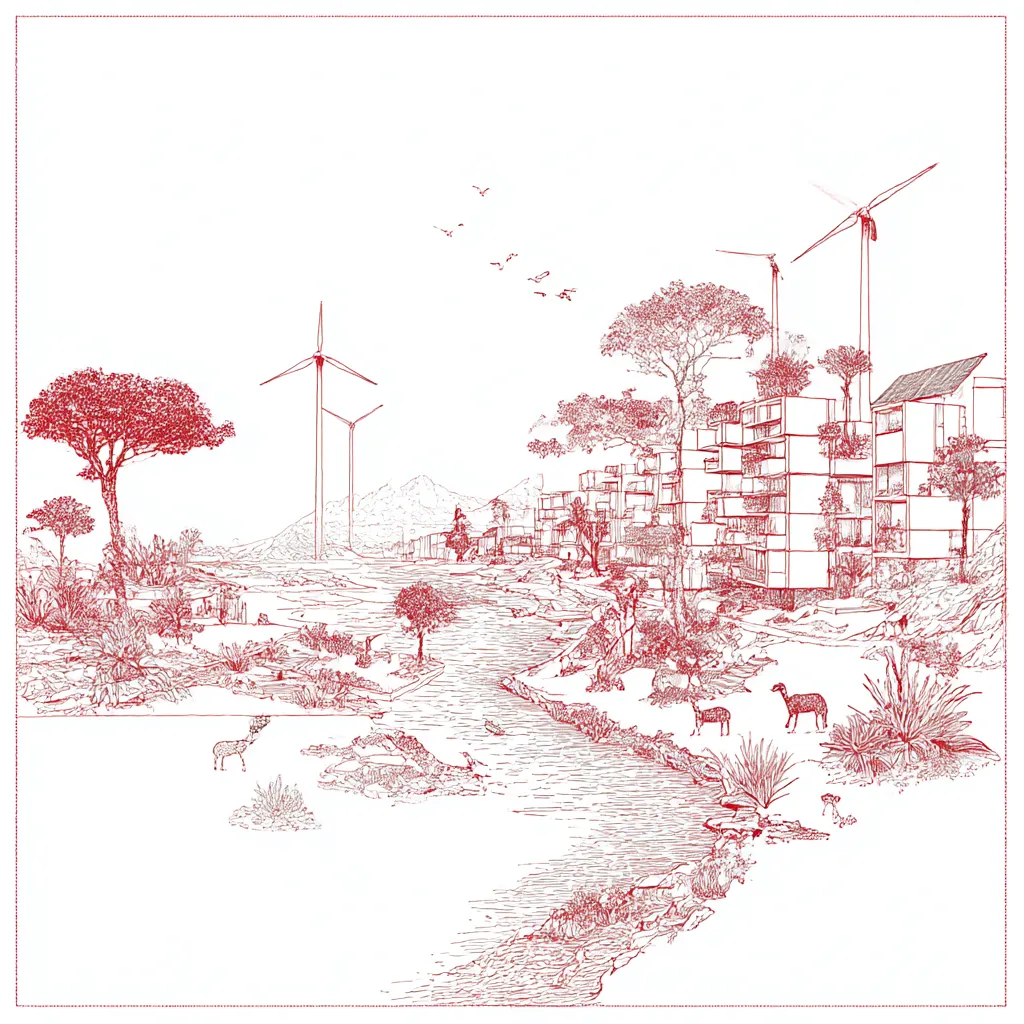
Ecological Embeddedness means that governance operates within biophysical limits. This is not an environmental policy position. It is a recognition of physical reality. The economy is a subsystem of the ecology, not the reverse. Human civilization depends on functioning ecosystems — clean air, clean water, stable climate, fertile soil, biological diversity — and no political arrangement can override that dependence. Natural systems (rivers, forests, watersheds, ecosystems, species) possess intrinsic value and legal standing independent of their utility to humans. They are not merely resources to be managed but living systems with their own right to exist, flourish, and regenerate. Future generations and non-human ecological systems require structural representation in governance, including legal standing, guardianship mechanisms, and enforceable rights. Rhetorical acknowledgment is not enough.
Embeddedness, Not Stewardship
The framing matters. “Environmental stewardship” implies that humans stand outside nature and manage it responsibly. “Ecological embeddedness” means something different: humans are part of ecological systems. We are biological organisms, dependent on the same air, water, and soil as every other living thing, participants in the same cycles of energy and matter, subject to the same biophysical constraints. We do not govern nature. We govern ourselves within it.
This distinction also separates embeddedness from even well-intentioned resource management. A stewardship frame treats nature as something we manage responsibly, as shared wealth held in trust. That is necessary but insufficient. Rights of nature is a different ontological claim: natural systems are not resources to be managed, even responsibly. They have intrinsic value and standing independent of their utility to humans. A river is not merely a water supply to be allocated wisely. It is a living system with its own right to flow, to sustain the life within it, to exist as what it is. The shift from stewardship to rights is the shift from “we should take care of this” to “this has standing whether we take care of it or not.”
This is not a sentimental claim. It is the most hard-headed realism available. A governance framework that treats ecological systems as external resources to be exploited, managed, or “balanced” against economic growth is a framework built on a fiction about what humans are and where we live. The fiction that the economy can grow without limit on a finite planet, that ecological consequences can be deferred indefinitely, that technology will always arrive in time to fix what extraction has broken — these are not optimistic assumptions. They are delusions, and governance built on delusions will fail.
The connection to Human Primacy is direct and important. Human Primacy asserts the primacy of human judgment over machines in decisions about human rights. It does not assert human dominion over the natural world. The same biological grounding that makes human consciousness irreducible — our embodiment, our mortality, our emergence from living systems — is what makes the pretension of standing outside or above nature absurd. Human Primacy and rights of nature are allies, not opponents: both assert that biological life has a character and a standing that artificial systems do not share. Human Primacy draws the line between living consciousness and mechanical computation; Ecological Embeddedness draws the line between living systems and the economic abstractions that would reduce them to inputs. The logic is the same: life has standing. Human Primacy over AI and human embeddedness in ecology are two faces of the same recognition: we are biological beings, not abstract intelligences, and our governance must reflect that.
Biophysical Limits as Constitutional Constraints
Ecological limits are not policy preferences to be weighed against economic interests. They are constitutional constraints: conditions that governance may not authorize the violation of, regardless of the economic or political incentives to do so.
Economic activity that exceeds the carrying capacity of the ecological systems it depends on is not a trade-off. It is a form of self-destruction conducted in slow motion. The atmosphere’s capacity to absorb carbon dioxide is not a political question. The rate at which aquifers recharge is not subject to negotiation. The minimum viable population of a pollinating species is not a matter for cost-benefit analysis. These are physical realities, and a governance framework adequate to the 21st century must treat them as such.
This means that certain economic activities are constitutionally impermissible — not because a legislature has decided to regulate them, but because they exceed biophysical limits that no legislature has the authority to override. The right to extract fossil fuels does not trump the right to a stable climate. The right to clear-cut a forest does not trump the right of downstream communities to clean water. The right to profit does not trump the conditions of continued life. Ecological Embeddedness establishes the hierarchy: governance operates within biophysical limits, and economic activity operates within governance. Reverse either relationship and the system consumes its own foundation.
Rights of Nature
Rivers do not vote. Forests do not file lawsuits. Endangered species do not lobby. The atmospheric commons has no representative in any legislature on Earth. And yet the functioning of these systems is a precondition for everything governance exists to protect.
Ecological Embeddedness makes an ontological claim that goes beyond representation: natural systems possess rights. A river has the right to flow. A forest has the right to exist and regenerate. An ecosystem has the right to maintain its integrity. These rights are not derived from human utility, not from the economic value of the timber or the recreational value of the waterway. They are intrinsic, grounded in the recognition that living systems have value in themselves, independent of what they provide to humans.
This is not a novel legal theory. It is an emerging global reality. Ecuador’s constitution recognizes the rights of Pachamama (nature itself) to exist, persist, and regenerate. Bolivia’s Law of Mother Earth establishes nature as a collective subject of public interest with legally enforceable rights. New Zealand granted legal personhood to the Whanganui River and the Te Urewera forest, recognizing them as living entities with rights, standing, and designated guardians. Colombia’s Supreme Court recognized the Colombian Amazon as a legal subject with rights to protection, conservation, and restoration. These are not hypothetical proposals. They are functioning legal frameworks, drawing on indigenous legal traditions that Western jurisprudence is only now beginning to take seriously.
The constitutional framework this project articulates must go at least as far. Natural systems require not merely structural representation but legal standing: the right to exist, the right to flourish, and enforceable mechanisms to vindicate those rights. This means dedicated guardianship institutions empowered to bring claims on behalf of natural systems, governance structures that incorporate ecological knowledge into decision-making with binding force, and constitutional provisions that recognize the rights of nature as non-derogable.
The guardianship mechanism is critical. Rivers cannot appear in court. But the New Zealand and Colombian models demonstrate how this works in practice: a designated guardian or council speaks for the natural system, with legal standing to bring actions on its behalf. This is analogous to how guardians ad litem represent children or incapacitated persons. The mechanism is well established in law. The question is not whether natural systems can have standing but whether the constitutional framework mandates it. Ecological Embeddedness answers yes.
Indigenous governance traditions around the world have organized political life around relationships to land, water, and living systems for millennia, not as romantic primitivism but as sophisticated governance of human communities embedded in ecological realities. Many of these traditions already recognize what Western law is only beginning to articulate: that the land, the water, and the living systems are not property but relations, not resources but kin. Western political thought is late to this recognition, not early.
The structural challenge remains real: who speaks for the river? Who decides what the forest’s interests are? How is ecological representation made accountable? These are design problems, not objections. Epistemic Pluralism is relevant here: ecological governance requires multiple modes of knowledge (scientific monitoring, indigenous ecological knowledge, lived experience of communities embedded in specific landscapes) and no single mode is sufficient. The guardianship model ensures that someone with standing and resources can advocate for the natural system, while epistemic pluralism ensures that the knowledge informing that advocacy is drawn from all available sources.
Intergenerational Obligation
Ecological governance is inherently intergenerational. The consequences of ecological decisions made today will unfold over decades, centuries, and in some cases millennia. Carbon emitted now will warm the atmosphere for generations. Biodiversity lost now is lost forever on any timescale meaningful to human civilization. Aquifers depleted now will take thousands of years to recharge. Soil degraded now will not recover within any living person’s lifetime.
Future generations cannot vote, cannot lobby, cannot organize, and cannot hold current decision-makers accountable. If they are to have any representation at all, it must be structural: institutions specifically designed to advocate for their interests, empowered to constrain present consumption in the interest of future viability, and insulated from the short-term political pressures that make ecological governance so difficult.
Temporal Pluralism provides the architectural framework: slow institutions with genuine authority over decisions with long-term ecological consequences, insulated from the catastrophically fast tempo of election cycles and quarterly earnings reports. Universal Human Rights provides the moral ground: the right to a habitable environment is a right that extends to people who do not yet exist, and the living generation holds the ecological commons in trust for them. Intergenerational obligation is not charity toward the future. It is a structural recognition that consuming the conditions of future life is a rights violation as real as any present injustice.
Ecological Communities as Political Communities
Plural Sovereignty recognizes ecological communities (people who share a watershed, a coastline, a bioregion, or an environmental fate) as legitimate political communities with governance interests. Ecological Embeddedness is what makes this recognition necessary, and rights of nature deepens it.
Biophysical systems do not organize themselves along state lines. A river basin is a political community whether the law recognizes it or not: governance decisions upstream affect everyone downstream, and the people who share the basin share an environmental fate that no administrative boundary can sever. The same is true of airsheds, aquifers, fire-prone landscapes, and coastal zones. These are communities created by ecological reality, and they need governance structures that match.
If natural systems have rights, then ecological systems are themselves a form of overlapping sovereignty. The watershed does not respect municipal boundaries. The forest does not care about state lines. The migratory corridor crosses every jurisdiction it passes through. Ecological governance must match ecological geography, and that is itself a form of plural sovereignty: not just human communities organized around shared ecological fate, but the ecological systems themselves as entities with standing that governance must recognize. This is a radical extension of Plural Sovereignty, but it follows directly from the recognition that natural systems have intrinsic value and legal standing.
This is one of the strongest arguments for moving beyond purely geographic federalism. The states that share the Colorado River have competing interests that the river’s ecology does not care about, and the river itself has interests that none of those states adequately represent. The communities that share a fire-prone landscape need coordinated governance that county lines do not provide. The people who breathe the same air need representation that acknowledges their shared ecological condition. Plural Sovereignty provides the constitutional framework for recognizing these communities and these systems. Ecological Embeddedness provides the reason.
Wealth, Consumption, and Ecological Limits
Extreme wealth is an ecological problem, not just an economic one.
The wealthiest fraction of the global population is responsible for a vastly disproportionate share of carbon emissions, resource consumption, and ecological destruction. Private jets, multiple residences, luxury consumption, and the investment patterns of concentrated wealth drive ecological degradation at a scale that dwarfs the impact of ordinary consumption. Unlimited accumulation is incompatible with a finite planet. This is arithmetic, not ideology.
Economic Democracy addresses wealth concentration as a threat to democratic self-governance. Ecological Embeddedness adds a second, independent reason for structural limits on accumulation: a society living within biophysical limits necessarily constrains the degree of material inequality it permits. Not because equality is ecologically optimal, but because extreme wealth drives extreme consumption, and extreme consumption exceeds the carrying capacity of the systems we depend on.
This also means that the growth imperative built into contemporary economic systems is itself a governance problem. An economy that must grow to remain stable, in a biosphere that cannot sustain unlimited growth, is a system at war with its own material conditions. Ecological Embeddedness does not prescribe a specific economic model, but it rules out any model premised on infinite growth in a finite system.
The Commons Dimension
The atmosphere, the water cycle, the soil, biodiversity, the electromagnetic spectrum, the genetic commons — these are shared wealth. They are not owned by anyone and they cannot be legitimately enclosed.
The Inalienable Commons provides the structural framework for managing shared resources collectively. Ecological Embeddedness provides the deeper ground: these are not just shared resources in the economic sense. They are the systems that sustain life itself. The atmosphere is not a resource to be allocated. It is the medium in which every air-breathing organism exists. The water cycle is not an asset to be managed. It is the circulatory system of the living planet. The soil is not a factor of production. It is a living community of organisms more complex than any human society.
Treating these systems as resources to be managed, allocated, and optimized is itself a symptom of the failure to understand embeddedness. We do not manage the ecology. We participate in it. The Inalienable Commons provides the governance framework for managing shared wealth collectively; Ecological Embeddedness insists that these systems are more than shared wealth. They are living systems with rights of their own. Governance that recognizes this will look different from governance that does not: less like resource management and more like the maintenance of relationships on which our continued existence depends, and in which the other parties have standing.
Relationship to Other Principles
Ecological Embeddedness touches every other principle in the framework, but several connections are especially load-bearing:
Human Primacy and Ecological Embeddedness are complementary, not contradictory. Human Primacy asserts that human judgment must govern decisions about human rights — primacy over machines. Ecological Embeddedness asserts that human governance operates within biophysical limits — embeddedness within nature. The biological grounding is the same: humans are living organisms, not abstract intelligences, and our governance must reflect both our irreducibility and our dependence.
Plural Sovereignty gives ecological communities constitutional recognition. Without it, Ecological Embeddedness has no institutional home — no way to translate the reality of shared ecological fate into governance structures with authority.
Temporal Pluralism provides the slow institutions that ecological governance requires. Election cycles and quarterly earnings are catastrophically fast relative to the timescales on which ecological systems operate. Without institutions designed to operate on ecological time, the short-term will always override the long-term.
Subsidiarity & Solidarity connects through ecological crisis as a solidarity trigger. Natural disasters, ecological catastrophes, and climate displacement are among the crises that activate the solidarity obligation — and unlike many crises, they do not respect jurisdictional boundaries. Ecological solidarity is one of the strongest arguments for robust mutual obligation across the entire polity.
The Inalienable Commons is the institutional expression of the ecological commons. Atmosphere, water, soil, biodiversity — these are shared wealth that cannot be enclosed. Ecological Embeddedness establishes why they matter; The Inalienable Commons establishes how they are governed.
Universal Human Rights incorporates ecological and intergenerational rights on the floor: the right to a habitable environment, clean air, clean water, and a stable climate. These are not aspirational goals. They are non-derogable rights, and the living generation’s obligation to future generations is as binding as any other commitment on the floor.