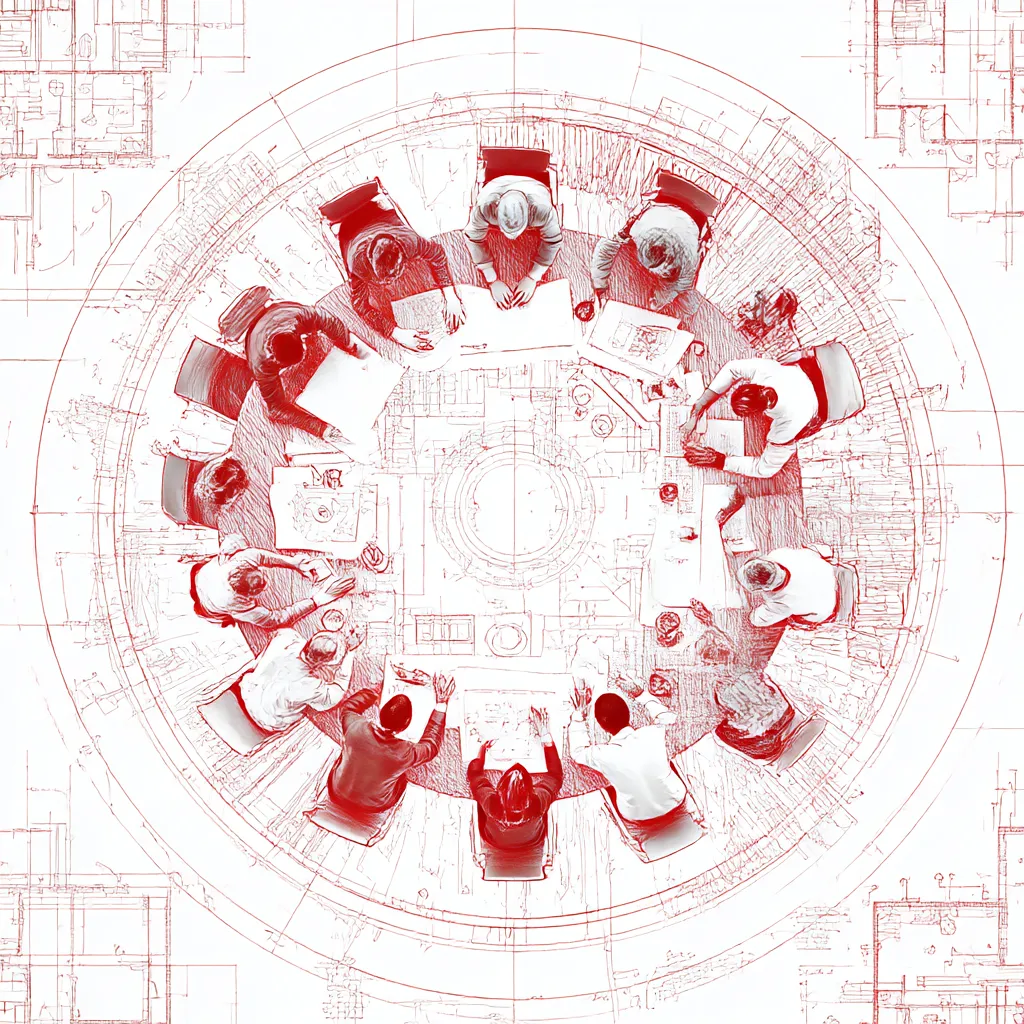
Economic Democracy is the right to participate in the governance of economic institutions that affect one’s life. Extreme concentration of wealth is inherently incompatible with democratic self-governance: a society with billionaires is not a democratic society, because the degree of power asymmetry negates any meaningful sense of shared self-governance. A democratic society maintains structural limits on accumulation, structural protections for labor, and structural preference for economic forms that distribute rather than concentrate power.
Wealth Concentration as Inherently Anti-Democratic
The standard liberal framing treats wealth inequality as a problem only when it “distorts” politics, through campaign contributions, lobbying, or regulatory capture. This framing is inadequate. Extreme wealth concentration is incompatible with democratic self-governance regardless of whether the wealthy engage in politics directly.
The reason is power. A person who controls the employment of thousands of people, the housing conditions of a community, the information infrastructure of a nation, or the investment patterns that shape entire economies exercises a form of power over other people’s lives that is functionally governmental. It does not matter whether that power is exercised through the political system or around it. The degree of asymmetry, where a handful of individuals hold more power than the vast majority of citizens combined, negates any meaningful sense of shared self-governance.
Democracy requires a rough equality of power among citizens, not identical outcomes but a distribution in which no individual or small group can dominate the conditions of life for everyone else. Extreme wealth concentration destroys this condition. A society in which the richest individuals have more influence over the material conditions of life than the elected government is not a democracy in any substantive sense, regardless of what its constitution says.
Structural Limits on Accumulation
A democratic society maintains structural limits on accumulation, not merely on the translation of wealth into political power, but on the degree of material inequality itself.
This is a stronger claim than most progressive frameworks make. The usual approach is to accept unlimited accumulation and then try to prevent the wealthy from converting their economic power into political power. Economic Democracy rejects this approach as structurally insufficient. The power that comes with extreme wealth does not require political channels to undermine democracy. A billionaire who never donates to a campaign, never lobbies a legislator, and never runs for office still exercises a degree of power over other people’s lives that is incompatible with democratic equality. The problem is the concentration itself.
Where exactly the threshold lies between legitimate reward and anti-democratic concentration is a genuine question, and one that democratic deliberation must answer. The framework does not propose a specific number. What it insists on is the principle: there is a threshold beyond which wealth concentration becomes incompatible with democratic self-governance, and a democratic society must maintain structural mechanisms to prevent that threshold from being crossed. Innovation, entrepreneurship, and individual initiative are real and valuable. They do not require or justify unlimited accumulation.
Dynastic Wealth as Hereditary Aristocracy
The founders rejected hereditary political titles but failed to prevent hereditary economic power, which has become functionally equivalent. Dynastic wealth reproduces class across generations, undermines equality of opportunity, creates a permanent oligarchic class, and concentrates ownership of productive assets in fewer and fewer hands over time.
The inherited American principle of rejecting hereditary political status, taken seriously, demands structural constraints on intergenerational wealth transmission. This is not a tax policy question. It is a democratic design question. A society that allows unlimited inheritance of concentrated wealth is recreating the aristocratic class system its founding was supposed to reject. The prohibition on titles of nobility was never just about the titles. It was about the concentration of inherited power that titles represented. Economic Democracy extends that commitment to its logical conclusion.
The Corruption of Political Participation
The translation of economic power into political power through campaign contributions, lobbying, political advertising, and the revolving door between public office and private interest is a fundamental corruption of democratic governance.
The right to participate in democratic processes belongs to persons, not to economic entities, and is not proportional to wealth. This is a structural commitment, not a regulatory preference. It means that the current system, in which political influence is roughly proportional to the money spent acquiring it, is not a flawed democracy. It is a functioning plutocracy with democratic characteristics.
Campaign contributions buy access. Lobbying buys policy. The revolving door converts public authority into private benefit. Dark money hides the identity of those exercising influence. Political advertising, especially through targeted digital platforms, industrializes the manipulation of political judgment at scale. Each of these mechanisms translates wealth into political power, and each is a form of corruption whether or not it violates current law.
Democratic Sovereignty over Institutions addresses the institutional structures through which this corruption operates. Economic Democracy addresses the underlying condition that makes it possible: the existence of concentrated wealth sufficient to purchase political outcomes. Both are necessary. Limiting the channels of influence without limiting the concentration of wealth is a game of whack-a-mole that wealth always wins.
Workplace Democracy and Labor Rights
The right to participate in the governance of economic institutions begins at work. The current arrangement, in which most people spend the majority of their waking hours in institutions where they have no meaningful voice, is a fundamental democratic deficit.
Workplace democracy is not a privilege granted by employers. It is a corollary of democratic self-governance. If the principle is that people have the right to participate in the governance of institutions that affect their lives, then the institutions where they spend most of their time and from which they derive their livelihood are the most obvious application. The right to organize, to bargain collectively, and to participate in the governance of the enterprise is as fundamental as the right to vote.
Labor rights are floor guarantees under Universal Human Rights: the right to work under fair conditions, to organize and strike, to equal pay for equal work, to limits on working hours, to rest and leisure. These are not policy preferences. They are the material conditions of freedom. A person who must accept any terms of employment in order to survive is not free in any meaningful sense.
Cooperative and commons-based models of ownership are structurally favored over extractive ones. This does not mean mandating a single economic form. It means that the legal, tax, and regulatory environment is designed to encourage ownership structures that distribute power and wealth rather than concentrate them. When workers own the enterprise, the profits of labor flow to those who produce them rather than to distant shareholders. When productive assets are held in common, the gains from collective effort are shared collectively. These are not radical propositions. They are the economic expression of democratic principle.
Wealth as Extraction, Not Creation
The mythology of wealth “creation” obscures the reality that extreme wealth is accumulated through structural advantages: monopoly power, rent-seeking, exploitation of labor, enclosure of commons, regulatory capture, tax avoidance, and the compounding advantages of existing wealth.
Much of what is counted as private wealth was built on publicly funded research, publicly maintained infrastructure, commonly held natural resources, and the unpaid or underpaid labor of others. The internet was not created by tech billionaires. GPS was not invented by a rideshare company. The basic science behind every major pharmaceutical advance was funded by public investment. When private actors enclose these collectively produced assets and claim the resulting profits as their own creation, they are not creating wealth. They are appropriating it.
The Inalienable Commons addresses the enclosure of shared wealth directly. Economic Democracy addresses the broader pattern: an economic system that systematically transfers collectively produced value to a shrinking ownership class is not a market economy. It is an extraction economy, and it is incompatible with democratic self-governance.
The Financial System and Rentierism
A large and growing share of concentrated wealth is derived not from production but from rent extraction: on debt, housing, intellectual property, financial instruments, and data. The financial system has been transformed from a mechanism for allocating capital to productive uses into a mechanism for extracting wealth from the productive economy.
When wealth can be accumulated faster through financial engineering than through productive activity, the incentive structure of the entire economy is distorted. Capital flows toward speculation rather than investment. Housing becomes an asset class rather than shelter. Debt becomes a mechanism of extraction rather than a tool of opportunity. The financial system exists to serve the productive economy and the common welfare, not the reverse, and Economic Democracy insists on structural mechanisms to maintain that relationship.
The Ecological Dimension
Extreme wealth is an ecological problem as well as a democratic one. The wealthiest fraction of the global population is responsible for a vastly disproportionate share of carbon emissions, resource consumption, and ecological destruction. Private jets, multiple residences, luxury consumption, and the investment patterns of concentrated wealth drive ecological degradation at a scale that dwarfs ordinary consumption.
Ecological Embeddedness establishes that governance operates within biophysical limits. Economic Democracy adds that unlimited accumulation is incompatible with those limits. A society living within ecological constraints necessarily constrains the degree of material inequality it permits. This is not a matter of ideology. It is arithmetic: extreme wealth drives extreme consumption, and a finite planet cannot sustain unlimited consumption by anyone, regardless of how it is distributed.
Relationship to Other Principles
Democratic Sovereignty over Institutions addresses the institutional structures through which economic power translates into political power. Economic Democracy addresses the concentration of wealth that makes the translation possible. Together they form a two-pronged response: constrain the channels and constrain the source.
The Inalienable Commons addresses one of the primary mechanisms of accumulation: the enclosure of shared wealth. Economic Democracy and the Inalienable Commons are complementary. One constrains the degree of inequality; the other closes a principal pathway through which inequality is produced.
Universal Human Rights establishes the material baseline that economic democracy must fund. If people have fundamental rights to education, healthcare, housing, and meaningful participation, and those rights require resources, then a system that permits unlimited accumulation while those rights go unmet is self-contradictory. The Rights Floor implies structural limits on the degree of inequality a democratic society can tolerate.
Subsidiarity & Solidarity connects through the fiscal dimension. Subsidiarity requires that devolved authority include the fiscal capacity to exercise it. Wealth extraction hollows out communities, stripping them of the resources that meaningful self-governance requires. Structural limits on accumulation are a precondition for subsidiarity to function.
Ecological Embeddedness provides a second, independent reason for structural limits on accumulation: a finite planet cannot sustain unlimited concentration of consumption. Economic Democracy and Ecological Embeddedness converge on the same conclusion from different directions: one from democratic principle, the other from biophysical reality.